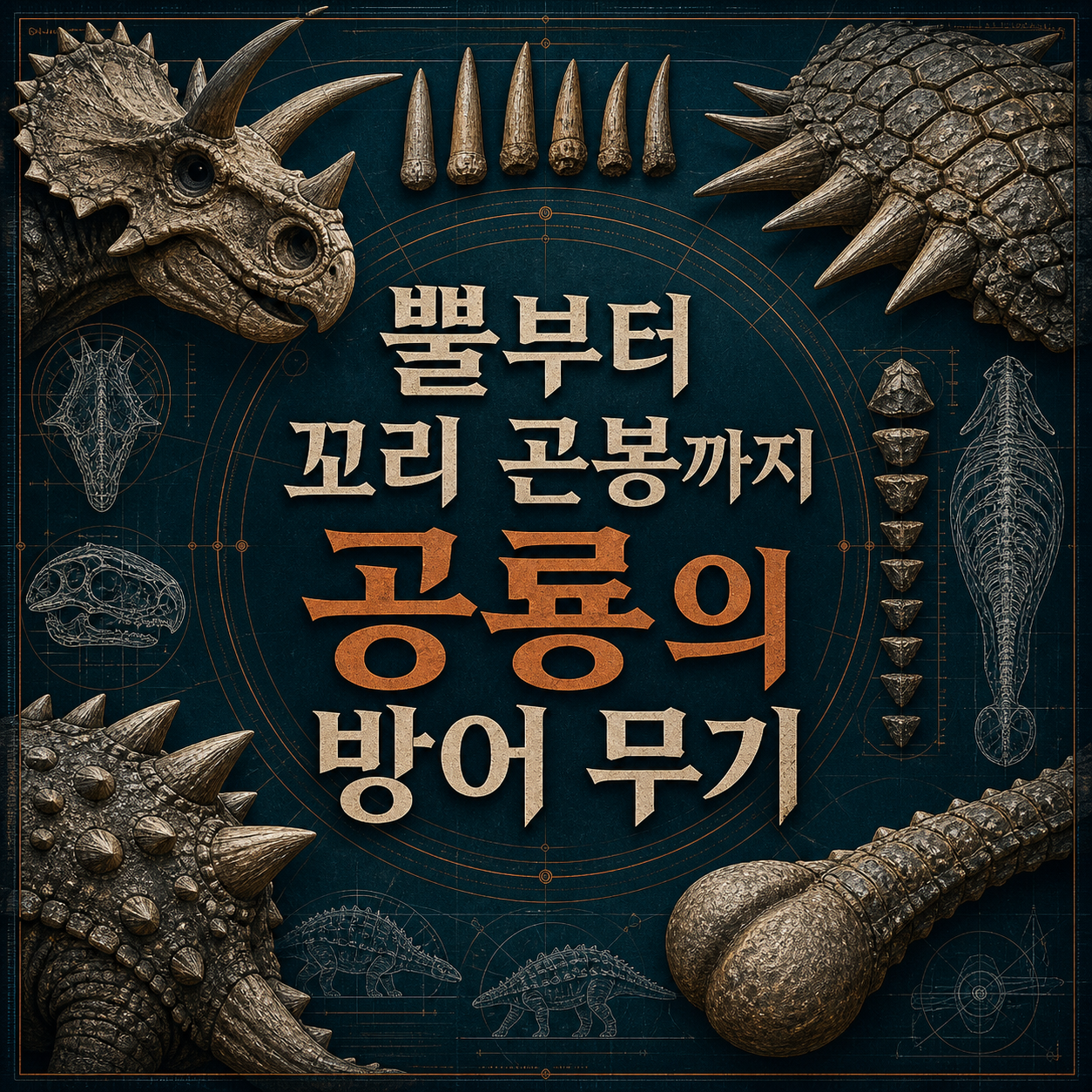
Ten dinosaur defenses, from Triceratops horns to the Ankylosaurus tail club, explained through fossil evidence and still-unresolved debates.
Whether Triceratops fought with its horns or simply displayed them to attract a mate is still debated. Plant-eaters weren't always fleeing predators — Triceratops used horns, Ankylosaurus a tail club, Stegosaurus tail spikes, each a possible defense. A striking structure like these rarely served one purpose alone — display, recognition, and rivalry within the species may have mattered too.
This list weighs each defense against fossil evidence — healed injuries, joint range of motion, and shape changes across growth. Comparing weapon size alone misses which direction a structure moved and what it protected. Separating confirmed anatomy from interpretation is the key here.
Selection Criteria
- Direct fossil evidence, like healed injuries or lesions
- Whether the joint could actually move that way
- Whether the structure is unusual among related dinosaurs
- Whether display or signaling is also considered
Triceratops's horns and frill

Ankylosaurus's tail club

Stegosaurus's tail spikes

Borealopelta's armor and camouflage

Styracosaurus's long frill spikes

Pachycephalosaurus's thickened skull

Iguanodon's thumb spike

Diplodocus's long tail

Edmontosaurus's large body and herd-movement evidence

Saltasaurus's embedded back plates

How to Read This List
For direct-confrontation weapons, start with #1 Triceratops's horns, #2 Ankylosaurus's tail club, and #3 Stegosaurus's tail spikes — the fossil damage behind them is solid.
For non-impact strategies, check #4 Borealopelta's camouflage and #9 Edmontosaurus's herd evidence first. Keep other functions like display or rivalry in mind rather than assuming pure defense.
This reflects research known as of September 2026; new findings could change these interpretations.
Frequently asked questions
How do scientists know how dinosaurs actually behaved?
There's no direct observation to work from, so behavior is reconstructed indirectly from healed bone injuries, footprints, nests, bite marks, and comparison with living animals. That's why researchers can read the same fossil differently, and why new specimens or methods can revise earlier explanations.
Were horns and spikes only used for fighting?
Probably not exclusively. Alongside defense, they likely served display toward potential mates, competition within the same species, and species-recognition signals. Recent research increasingly treats a single structure as serving several functions at once rather than one.
Did being large actually help with defense?
Large body size and herding likely helped detect predators earlier and protect younger animals. That said, a fossil bed showing many individuals together doesn't always represent an intact living herd, so that evidence needs to be read carefully.
Which defensive structure was the strongest?
Fossil evidence alone doesn't support ranking these by raw strength. Structures with clear damage patterns, like Triceratops's horns and Ankylosaurus's tail club, are judged more likely to have seen real use, but that doesn't mean other structures were less effective. Size and actual striking force are separate questions.
Why are dinosaur defenses so varied?
Different habitats, different predators, and different body types and movement styles likely pushed defense in different directions — toward horns, armor, spikes, sheer size, or herding. Even dinosaurs solving the same problem could end up with completely different structures depending on their evolutionary path.
Get new lists before anyone else
Once a week — only the new lists worth your time.
No spam · unsubscribe in one click
You may also like

How Scientists Actually Monitor a Volcano Before It Erupts
No single signal predicts an eruption; scientists layer seismic, deformation, gas, thermal, satellite, and geologic data instead, and here's how each method works.

Long Before Flight — Ten Fossil Clues That Link Dinosaurs to Birds
From feathers and the wishbone to brooding posture, ten pieces of fossil evidence traced in the order they appeared on the path to modern birds.
Ten Fossils That Made Paleontologists Rewrite the Dinosaur Textbook
From gray reptile to feathered, social, possibly semi-aquatic animal: ten fossil finds that forced scientists to redraw dinosaurs, and what each one actually proved.
Dinosaur Play Turns Into Science the Moment You Ask 'What Do You Think Happens?'
Ten at-home dinosaur science activities ranked by age fit and how many materials you need, built around predicting, observing, and explaining.