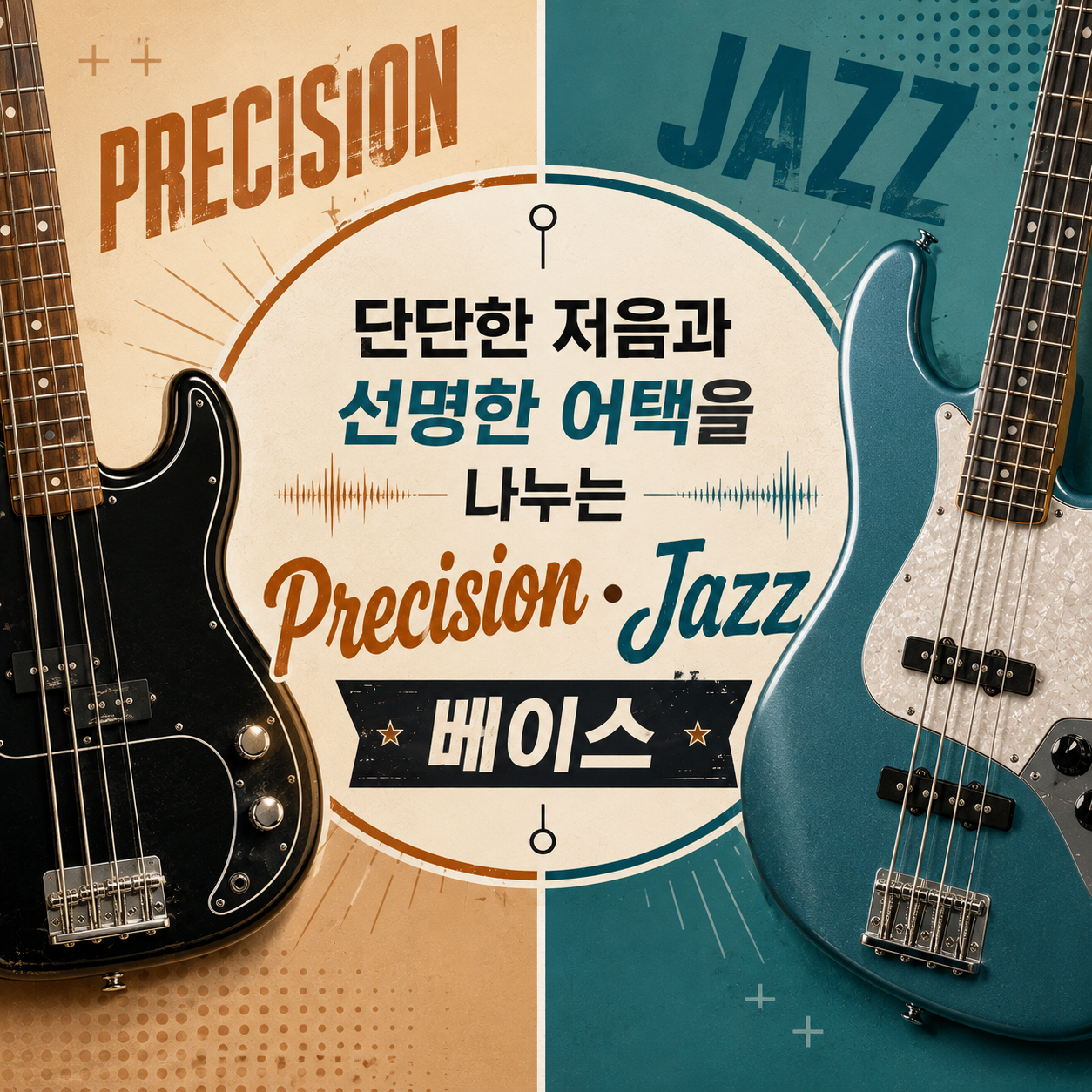
P pickups bring a thick, blunt midrange and J pickups bring a clearer attack, so the right choice depends on genre and your role in the band.
Which of Precision or Jazz suits your playing is half answered once you know the pickup design. A P uses one split-coil pickup for a thick, blunt midrange, while a J splits two single-coil pickups between bridge and neck for a clearer attack and a wider tonal range. The trouble is that a spec sheet rarely lets you hear that difference, and PJ hybrids make the choice even harder.
This list pairs P and J versions from the same brand at similar price points. Nos. 1 and 2 are the Player II pair, Nos. 3 and 4 the American Professional II pair, Nos. 5 and 6 the Squier Classic Vibe pair, and Nos. 8 and 9 the Sire Marcus Miller pair. Nos. 7 and 10 are PJ layouts with both pickups on one body. The order reflects good pairs to compare, not a ranking of quality. Specs and prices are as of September 2026 and may change.
How to read it
- New to this? Start with the Squier pair at Nos. 5 and 6 to learn the difference
- Mostly rock or punk? Start with the P models (Nos. 1, 3, 5, 8)
- Finger nuance and slap matter? Start with the J models (Nos. 2, 4, 6, 9)
- Want both on one bass? Check the PJ layouts (Nos. 7, 10)
Fender Player II Precision Bass
Fender Player II Jazz Bass
Fender American Professional II Precision Bass
Fender American Professional II Jazz Bass
Squier Classic Vibe '60s Precision Bass
Squier Classic Vibe '60s Jazz Bass
Yamaha BB434
Sire Marcus Miller P5
Sire Marcus Miller V5
Fender Duff McKagan Deluxe Precision Bass
How to choose
To train your ear on P versus J, the Squier pair at Nos. 5 and 6 is the lowest-pressure route; if your worry is the low end getting buried in a band, look at the P models at No. 1 or No. 3 first. If fingertip nuance and slap matter most, J models such as Nos. 2, 4, and 9 fit well. For one versatile bass, the PJ layouts at Nos. 7 and 10 are the compromise.
When comparing, play back to back on the same amp at the same volume and weigh midrange thickness, attack clarity, and neck feel together. Information reflects the research date and may change, so confirm with official channels before buying.
Frequently asked questions
Should beginners learn on a P or a J first?
There is no fixed answer. Players chasing forceful low end for rock or punk often start on P, and those wanting nuanced finger expression and tonal range often start on J. The fingering feel is similar enough that switching later is not a big leap.
Which side does a PJ configuration lean toward?
It depends on how you blend the volume knobs. Favor the P side and the midrange thickens; favor the J side and the attack comes forward. It is a practical compromise if you want both characters from one instrument.
Which is more common by genre, P or J?
P tends to show up more in rock, punk, and metal where amps run loud, and J tends to show up more in jazz, soul, and funk where finger nuance matters. These are tendencies, not hard rules.
Where does the sound difference between P and J come from?
Mostly from pickup design and placement. A P uses one split coil for a thick midrange, while a J splits two single coils between bridge and neck, giving a clearer attack and more room to blend tones.
Which models are good for comparing P and J?
The lowest-cost route is playing the No. 5 Squier Classic Vibe '60s Precision and the No. 6 Jazz back to back on the same amp at the same volume. With more budget, the Player II pair at Nos. 1 and 2 or the American Professional II pair at Nos. 3 and 4 also work well.
Which PJ basses are on this list?
The No. 7 Yamaha BB434 and the No. 10 Fender Duff McKagan Deluxe Precision Bass put P and J pickups on one body. Circuits and designs differ even among PJ layouts, so it is best to play them and hear the character yourself.
Get new lists before anyone else
Once a week — only the new lists worth your time.
No spam · unsubscribe in one click
You may also like

Chasing Low B: Where 5-String Active Basses Actually Differ
Low-B pitch stability, active EQ boost headroom, and neck width and scale are what actually separate five-string basses.

From Practice Room to Band Stage: A First Bass You Won't Outgrow
From Squier to Yamaha and Ibanez, here are 10 beginner basses picked with neck and pickup choices that won't force a second purchase later.

Martin Dreadnoughts: What the Low End Actually Gives You for Rhythm
Across Martin's dreadnought lineup, wood pairing and bracing — not sheer volume — decide how the bass holds together under a hard strum.

000 or OM: Let Your Fingers Decide
Despite sharing the same waisted Auditorium shape, Martin's 000 defaults to a shorter scale and the OM to a longer one, a real difference in tension, string spacing, and chord reach.