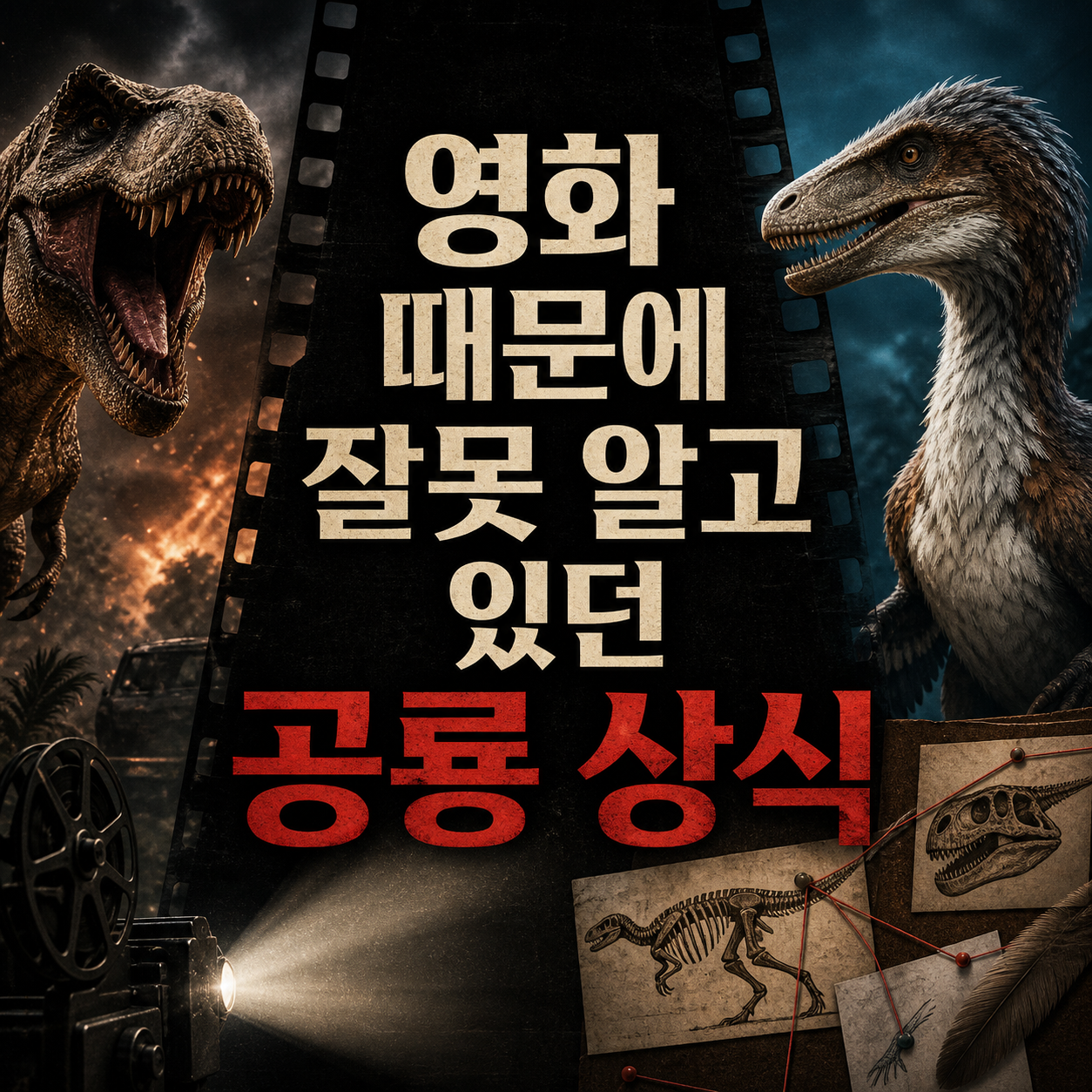
From Velociraptor's real size and T. rex's actual posture to feathers, roars, and when each species actually lived, ten dinosaur myths from the movies checked against fossil evidence.
For most of us, dinosaur knowledge starts with movies and old-school reconstruction art rather than documentaries. That's made dinosaurs feel familiar, but it also let some dramatic choices, like Velociraptor's size or T. rex's gait, calcify into "facts" that aren't quite true. This list revisits ten myths that keep showing up on screen, checked against fossil evidence and current research.
Rather than piling on the movies for getting it wrong, it helps to separate what science knew at the time from what storytelling demanded. Dinosaur reconstructions get revised constantly as new specimens turn up, and even today's most up-to-date illustrations aren't the final word.
How to tell the difference
- What's directly confirmed by fossils (skeletons, footprints, and the like)
- What's inferred by comparison to living relatives
- What's pure invention for the sake of the story
Once you can tell those three apart, you can enjoy the movies and still keep the facts straight — good material for conversation if you're watching with kids, too.
Not Every Dinosaur Was a Giant
Pterosaurs Weren't Flying Dinosaurs
Mosasaurs and Plesiosaurs Weren't Dinosaurs Either
Velociraptor Wasn't Human-Sized
Dinosaurs Weren't Just Scaly
T. rex Didn't Stand Bolt Upright
Dinosaurs Didn't All Live at the Same Time
No One Actually Knows What Dinosaurs Sounded Like
The Asteroid Didn't Wipe Out Every Dinosaur
A Single Fossil Doesn't Give You the Whole Animal
How to watch these movies differently next time
For exaggerated size and appearance, check No. 1 and No. 4. For common classification mix-ups, No. 2 and No. 3. For posture and movement, No. 6. For things fossils simply can't tell us, like sound, No. 8. For extinction and the limits of reconstruction, No. 9 and No. 10.
Even for the same species, a newly discovered specimen can send its reconstruction back to the drawing board. This entry reflects research published as of September 2026; paleontology is a field where the consensus updates every time a new fossil turns up, so check current papers or a museum's own materials for the latest picture.
Frequently asked questions
Is a pterosaur technically a dinosaur?
No. Pterosaurs are close relatives of dinosaurs within the archosaur group, but they sit on a separate branch of the family tree as flying reptiles, not dinosaurs themselves. They're often lumped together because they shared the Mesozoic skies and ground, but their hip and limb structures are fundamentally different from a dinosaur's.
Why doesn't T. rex drag its tail like it used to in old pictures?
Fossil evidence from the hips, spine, tail joints, and footprints points to a posture where the spine and tail stayed roughly horizontal for balance, rather than an upright stance with a dragging tail. That older image has largely been revised by decades of subsequent research.
Do we actually know what dinosaurs sounded like?
Not precisely. Soft tissue like vocal cords rarely survives as fossils, so the roars in movies are largely invented. Researchers do study skull resonance structures and compare them to living relatives like birds and crocodilians to estimate a plausible range of sounds, but no one has an actual recording.
Why shouldn't I take movie dinosaurs at face value?
Movies prioritize storytelling over scientific accuracy, so details like size, posture, and color that fossils alone can't pin down often get dramatized. It also matters how much the science has moved on since a given film was made.
Are today's dinosaur reconstructions 100% accurate?
No. Even current reconstructions can be revised as new fossils or research emerge. A reconstruction is the best estimate available at a given point in time, not a settled conclusion.
Get new lists before anyone else
Once a week — only the new lists worth your time.
No spam · unsubscribe in one click
You may also like

How Scientists Actually Monitor a Volcano Before It Erupts
No single signal predicts an eruption; scientists layer seismic, deformation, gas, thermal, satellite, and geologic data instead, and here's how each method works.

Long Before Flight — Ten Fossil Clues That Link Dinosaurs to Birds
From feathers and the wishbone to brooding posture, ten pieces of fossil evidence traced in the order they appeared on the path to modern birds.
Ten Fossils That Made Paleontologists Rewrite the Dinosaur Textbook
From gray reptile to feathered, social, possibly semi-aquatic animal: ten fossil finds that forced scientists to redraw dinosaurs, and what each one actually proved.

Dinosaur Play Turns Into Science the Moment You Ask 'What Do You Think Happens?'
Ten at-home dinosaur science activities ranked by age fit and how many materials you need, built around predicting, observing, and explaining.