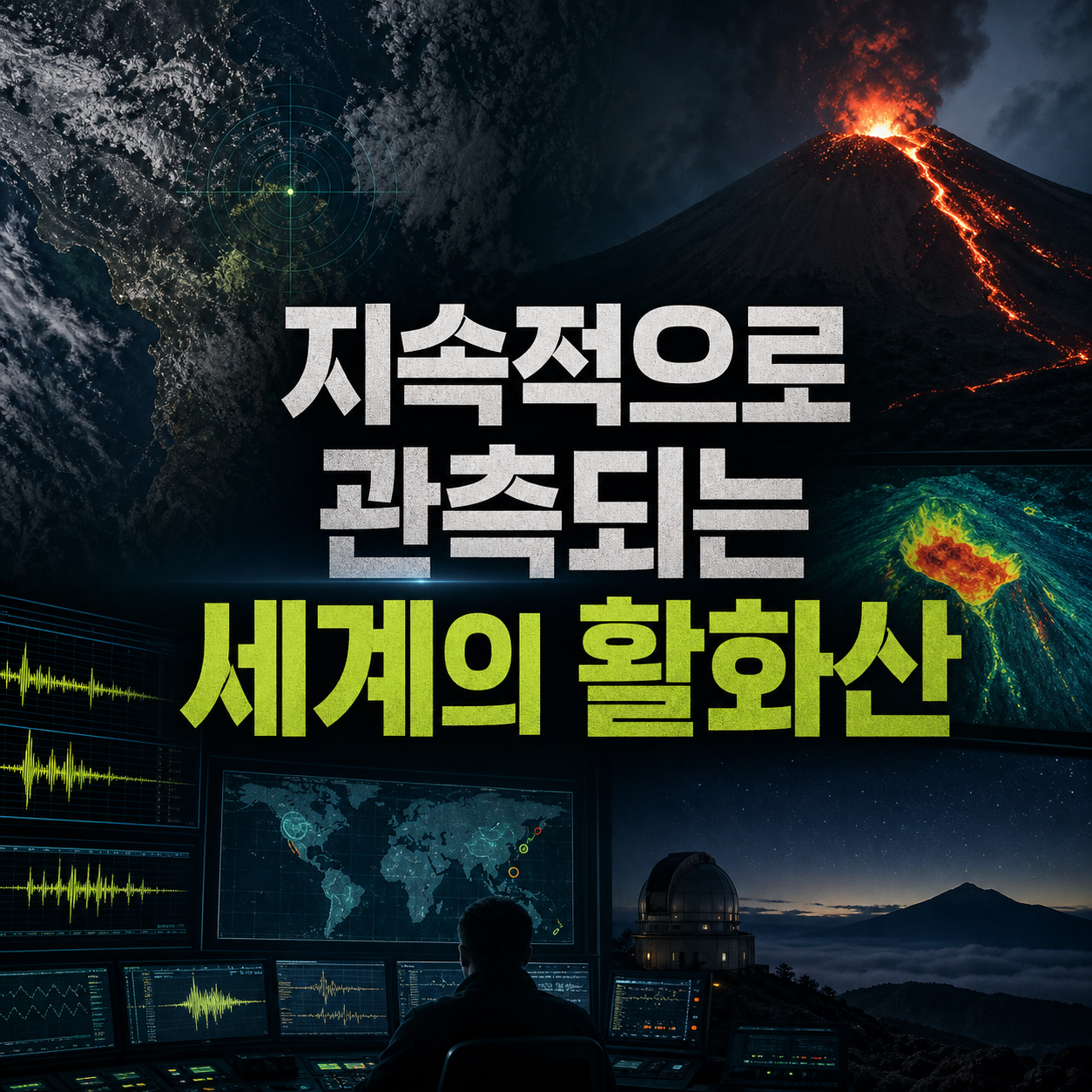
Ten volcanoes under constant watch — not for today's eruption count, but for recurring activity, nearby population, or aviation risk.
Calling a volcano "active" doesn't mean lava is flowing right now — it means another eruption remains geologically possible. Even a continuously erupting volcano can look calm for weeks. This list covers ten volcanoes that keep appearing in weekly observatory reports, and why each stays under watch.
Selection criteria
- Recurring activity: eruptions or tremors that repeat, not a one-time event
- Nearby population: towns within reach of pyroclastic flows, lahars, or ashfall
- Aviation risk: ash clouds that can reach flight paths and trigger alerts
- Scientific value: long-term research monitoring apart from population risk
Monitoring density differs by volcano, so this list isn't ranked by eruption count or plume height. Coordinates are map references, not access routes — check the latest alert level and restricted zones locally before visiting.
Mayon

Kilauea

Merapi

Popocatépetl

Stromboli

Etna

Semeru

Fuego

Sakurajima

Erebus

Sorting by risk type
By risk type, Mayon (No. 1) and Kilauea (No. 2) are lava-flow volcanoes, while Merapi (No. 3), Semeru (No. 7), and Fuego (No. 8) center on pyroclastic flows. Semeru adds lahars into downstream valleys, and Popocatépetl (No. 4) and Etna (No. 6) stay watched even for minor activity.
Stromboli (No. 5) and Sakurajima (No. 9) call for watching what breaks routine; Erebus (No. 10) is monitored for research, not risk. Alert levels shift constantly — check local authorities first.
Frequently asked questions
What's the difference between an active and a dormant volcano?
Broadly, a volcano is classified as active if it has erupted in geologically recent time (roughly the last 10,000 years) and could erupt again. That threshold varies slightly by monitoring agency, and volcanoes that stayed quiet for decades have reactivated before, so "dormant" is never a guarantee of safety.
Alert levels differ by country — can they be compared directly?
Even where numbered or color-coded levels exist, the criteria and the area they cover differ from country to country, so direct comparison is unreliable. When planning travel, follow the current level and restricted zone announced by the observatory for that specific volcano rather than comparing it to alert levels elsewhere.
What should I check before traveling near an active volcano?
Check the latest alerts, access restrictions, and flight advisories from the local volcano observatory or disaster authority before you go. A quiet-looking webcam feed doesn't mean nothing is happening — cloud cover or equipment issues can hide real activity, so official statements and on-site signage take priority over what footage suggests.
What exactly is a lahar?
A lahar is a fast-moving mudflow formed when volcanic ash or debris mixes with rainwater or melted snow and surges down a valley. As with Semeru, it can reach communities far downstream from the crater, so the danger zone needs to be judged by the whole valley, not just the area near the summit.
What's the difference between a lava flow and a pyroclastic flow?
A lava flow is molten rock moving relatively slowly, as at Kilauea, which often leaves room to track its path and respond. A pyroclastic flow, by contrast, is a fast-moving surge of hot gas, ash, and rock fragments — as seen at Merapi and Fuego — that gives far less time to evacuate.
Get new lists before anyone else
Once a week — only the new lists worth your time.
No spam · unsubscribe in one click
You may also like

Footprints Tell You More Than Bones Do — 10 Dinosaur Fossil Sites in Korea
Korea's dinosaur fossils are mostly footprints and egg nests, not bones. Ten sites, sorted by what they show, for reading 100 million years of history through those traces.
When Volcanoes Redraw the Map: Ten Cities That Had to Choose
Some cities came back from the ash. Others never did — here's what decided which.