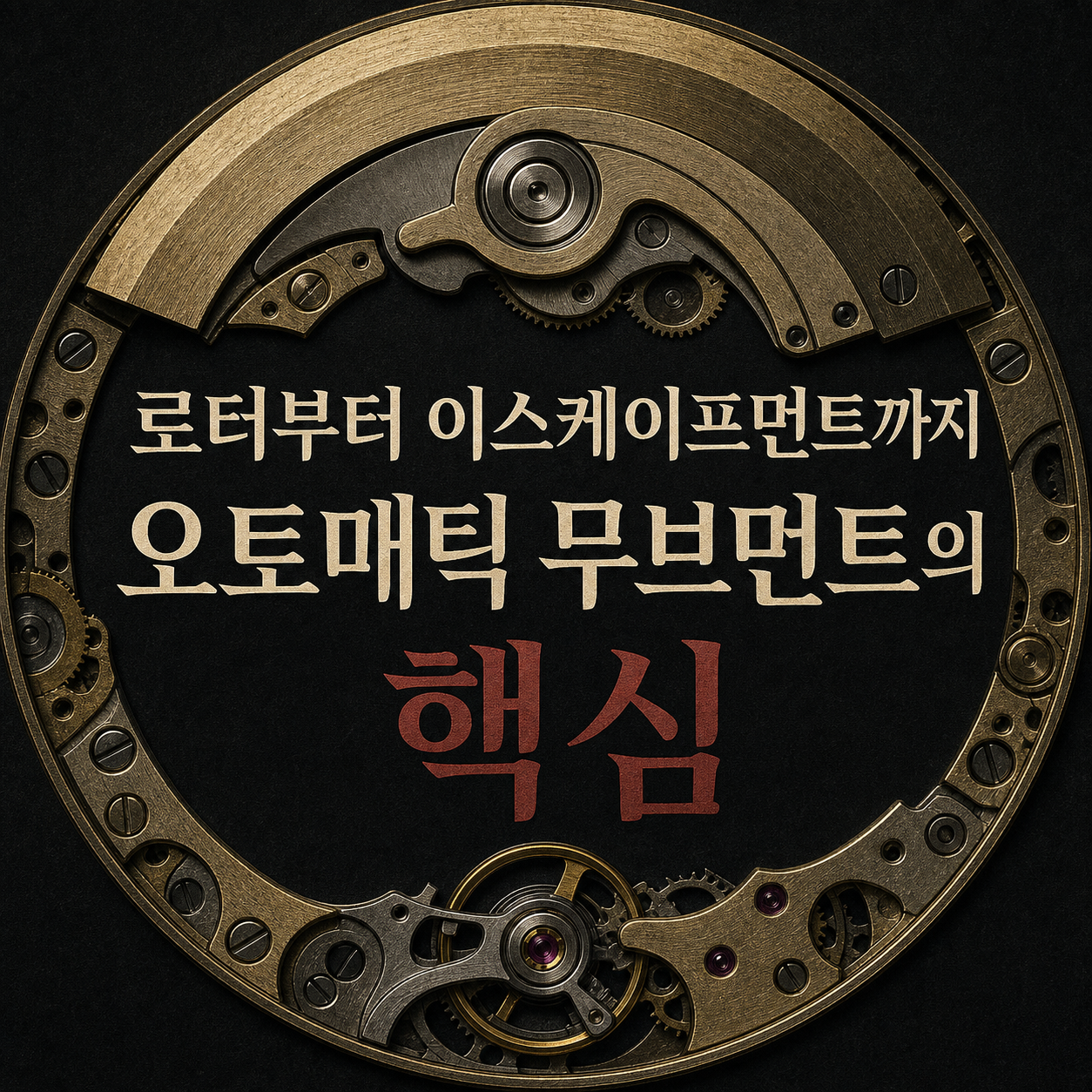
From the rotor's spin to the escapement's beat, these twelve parts trace how wrist motion becomes a mechanical watch's steady rhythm, in order.
Instead of memorizing automatic movement parts one by one, it is much easier to follow the path the power takes. Wrist motion turns the rotor, that rotation is stored in the mainspring, and the stored force passes through the escapement to become a steady beat. Once you see that chain, each part's place makes sense.
What people most often mix up is how the escape wheel, pallet fork, and balance wheel split the work, and whether a high jewel count really means a better watch. This list runs in the real order of power transfer, from where power is made, through where it becomes time, to the parts that guard against wear and overload, ranked 1 to 12.
How to read it
- Ranks 1-4: making and storing power
- Ranks 5-6: dividing and passing it on
- Ranks 7-10: turning power into a beat
- Ranks 11-12: guarding against friction and overload
The ranking shows sequence, not superiority. Use it as a map next time you look through a transparent caseback.
Rotor

Reversing Wheels & Winding Mechanism

Mainspring

Barrel

Gear Train

Center Wheel

Escape Wheel

Pallet Fork

Balance Wheel

Hairspring

Jewel Bearings

Slipping Bridle

How to choose what to look at
If you are learning the structure for the first time, read from rank 1, the rotor, to rank 12, the slipping bridle, in order. If power reserve interests you, start with rank 3, the mainspring, and rank 4, the barrel. For accuracy, look at the escapement section in ranks 7 to 10. If magnetism or shock worries you, remember rank 10, the hairspring.
When comparing watches, do not judge by a single number such as jewel count or beat rate; read the full specs together. If something feels wrong, do not open the case yourself and contact an authorized service center. This information reflects the time of research and may change, so confirm with official channels before buying.
Frequently asked questions
Can I actually see parts like the rotor or escapement through a display caseback?
If the caseback is sapphire crystal, you can usually see the rotor spinning and catch the escapement's fine movement with the naked eye. Exact part names and layouts differ by brand and caliber, though, so check your specific model's movement specs for the full picture.
Does a higher jewel count mean a better movement?
Jewel count simply reflects how many friction points the movement has, not a guarantee of accuracy or durability. Movements with more complications naturally tend to need more jewels, so it is more useful to look at the full spec sheet than to compare jewel counts alone.
How can I tell if something is wrong with the movement?
If the watch stops without explanation, the daily deviation grows much larger than usual, or something looks off through the caseback glass, have it checked at an authorized service center rather than opening it yourself. Disassembly and adjustment are jobs for trained technicians.
Why does an automatic watch stop if I do not wear it for a while?
Without wrist motion the rotor cannot wind the mainspring, and once the stored energy is used up the watch stops. When you start wearing it again, giving the crown a few turns by hand is the usual approach. Check the model's specs for its power reserve.
What does the slipping bridle do?
After the mainspring is fully wound, the bridle lets its end slip slightly inside the barrel so excessive tension does not build up. That keeps automatic winding going without the spring being overwound and damaged.
What does it mean that the hairspring is vulnerable to magnetism?
A metal hairspring exposed to a magnetic field can have its coils stick together, which speeds up the oscillation and can make the watch suddenly run fast. That is part of why more models now use silicon hairsprings. If you suspect it, have a service center check it.
Get new lists before anyone else
Once a week — only the new lists worth your time.
No spam · unsubscribe in one click
You may also like
Setting an Automatic Watch for the First Time: What to Check Before You Touch the Crown
Skip the generic 'wind it 20 times' advice -- your model's own manual comes first. A 12-step order from finding the caliber to locking the crown back down.
Before You Trust the Water-Resistance Number: What Actually Protects a Watch
The bar or ATM rating matters less day to day than whether the crown is properly closed and how recently the watch sat near a magnet.
A Bigger Power Reserve Number Doesn't Mean a Better Movement
The numbers on an automatic watch spec sheet aren't a scorecard — they describe different test conditions, and knowing what each one actually measures is what lets you pick the right watch.

Above $7,500: Reading Grand Seiko's Hi-Beat and Spring Drive Lines by Movement, Not Just Price
At the KRW 10 million-plus tier, hi-beat's ticking second hand and Spring Drive's continuous glide split these 12 Grand Seiko models.